
Our Success Stories · Case Study 01PharmaPrimes VBE Case Study
VBE Study for Clarithromycin 125 mg/5 mL Suspension
- The study was designed based on the observed clinical data for the reference drug.
- The 90% CI for Cmax was (87.89–101.92), while for the AUC0-t it was (86.221–97.154).
90% CI87.89–101.92Cmax
90% CI86.221–97.154AUC0-t
Clarithromycin Plasma Concentration
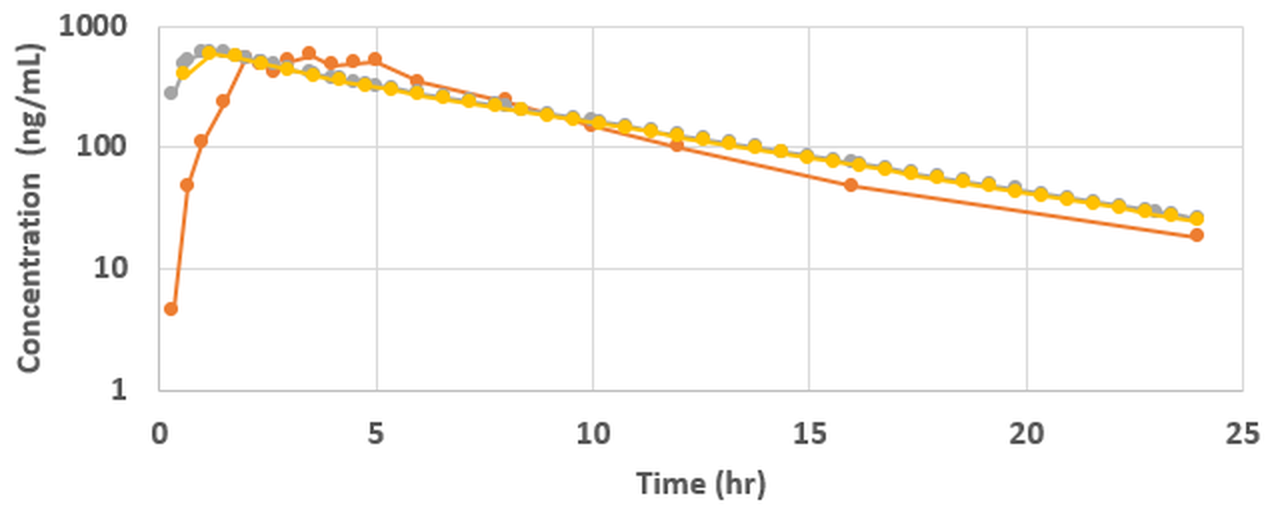
Observed RLDPredicted RLDPredicted test
Outcome Variables for the Clarithromycin VBE Study
| Parameter | Observed (reference) | Predicted (reference) | Observed (test) | Predicted (test) | Fold-difference |
|---|---|---|---|---|---|
| Cmax (ng/mL) | 690.45 | 663 | 767.856 | 600 | 0.96 |
| AUC0-t (ng.hr/L) | 3984.5 | 4549.4 | 4383.442 | 4141.9 | 1.14 |